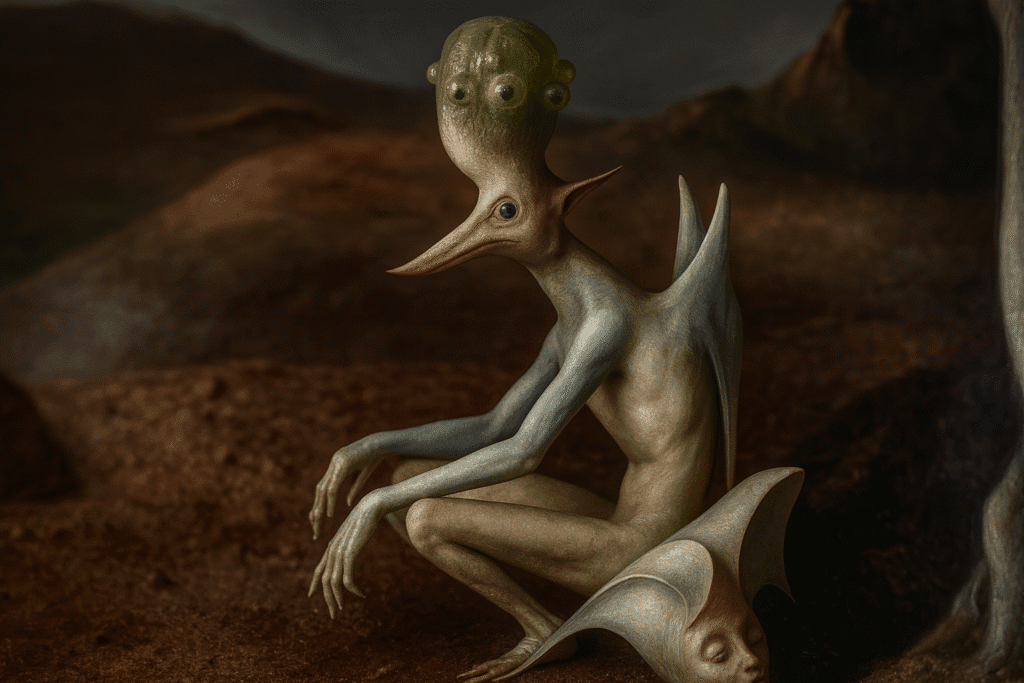
Introduction: The Hidden Folk of History
What if the strange lights in the sky weren’t technologically more advanced visitors from some nearby star system (relatively speaking), but instead neighbors we’ve always had, older, stranger, and hiding in plain sight?
The idea of crypto-terrestrials, intelligent beings that share the Earth with us but remain hidden, might sound like the stuff of fringe YouTube documentaries, but it sits at the crossroads of mythology, occult tradition, and modern surrealist art. From ancient folklore to 20th-century spirit phenomena to the melting dreamscapes of Salvador Dalí and Leonora Carrington, our cultural imagination has long danced with entities that dwell just beneath consensus reality.
This blog explores how the crypto-terrestrial hypothesis echoes through historical occult practices and morphs again in the brushstrokes of surrealism, suggesting a persistent cultural archetype: the presence of a concealed intelligence shaping, or reflecting, our own.
The Crypto-Terrestrial Hypothesis: A Primer
Coined and developed by Mac Tonnies in The Crypto-Terrestrials: A Meditation on Indigenous Humanoids and the Aliens Among Us (2010), the theory proposes that UAP (unidentified anomalous phenomena) might not originate from distant star systems but instead from a technologically advanced, secretive race co-inhabiting Earth.
Unlike traditional extraterrestrials (ET, Darth, or Elvis), these beings might live deep underground, at the bottom of a (so far) relatively unmapped ocean, or within nonphysical dimensions adjacent to our own. Tonnies drew not just from ufology, but also from folklore, paranormal cases, and high-strangeness phenomena that resist convenient classification.
This idea bears an eerie resemblance to folkloric entities found across cultures:
-
- The Tuatha Dé Danann in Irish mythology—supernatural beings who retreated into the hills when humans arrived.
-
-
- Djinn in Islamic mysticism—nonhuman intelligences who exist in parallel with humanity.
-
- The Shining Ones of Gnostic tradition—angelic or otherworldly beings tied to esoteric knowledge.
The crypto-terrestrial myth taps into deep-rooted fears and fascinations: that we are not alone, and that those who share our space may be more powerful, and more elusive than we ever imagined (caveat: I live in California, so this is par for our cultural zeitgeist).
Occult Echoes: Between Worlds and Veils
The occult revival of the 19th and early 20th centuries provides a trove of incidents and philosophies that map unnervingly well to modern crypto-terrestrial discourse. Figures like Aleister Crowley, Madame Blavatsky, and John Dee didn’t just dabble in the mystical; they claimed documented interactions with entities that fit the bill on crypto-terrestrial.
Aleister Crowley and “Lam”
In 1918, while conducting a ritual known as the “Amalantrah Working,” Crowley claimed to make contact with a non-human entity named Lam, a being he described and sketched as having a large head and small mouth, eerily similar to the “grey alien” archetype later popularized in UFO culture.
Crowley didn’t describe Lam as an alien but as an interdimensional intelligence accessible through ritual consciousness. Yet the imagery stuck. Occult historian Kenneth Grant (a Crowley disciple) later suggested Lam was a “gateway being” and that ceremonial magic could open portals to non-human intelligence. (Source: Kenneth Grant, “The Magical Revival,” 1972)
John Dee and the Enochian Entities
Back in the Elizabethan era, mathematician and court magician John Dee, along with his scryer Edward Kelley, received messages from what they believed were angelic beings speaking in a complex “Enochian” language. These communications detailed metaphysical cosmologies and warned of earthly cataclysms.
Skeptics dismiss this as self-induced psychosis or linguistic fraud, but the content, hyper-intelligent non-human entities communicating via consciousness, again mirrors modern reports of contact with UAP entities, many of which include telepathy, missing time, and altered perception.
Madame Blavatsky’s Ascended Masters
Theosophy, as propagated by Helena Blavatsky, introduced the idea of “Ascended Masters”, enlightened beings hidden from the world who guide human spiritual evolution. She claimed they resided in remote parts of the Earth (Tibet, the Himalayas, or other conveniently inconvenient locations), echoing earlier mythic archetypes of the crypto-terrestrial retreat.
Blavatsky’s writings fed directly into the New Age movement, which frequently blends UFO lore with spiritual transcendence.
Surrealism: Dreams of the Hidden Real
While occultists made contact with the unseen through ritual and channeling, surrealist artists sought the same through dreams, automatism, and the subconscious. Surrealism can be viewed as the aesthetic arm of crypto-terrestrial mythology, a visual language for expressing the uncanny presence of the “other” just beneath the real.
Leonora Carrington and the Feminine Otherworld
Carrington’s paintings, often filled with human-animal hybrids, shadowy priestesses, and ritual spaces, seem like illustrations from a crypto-terrestrial manual. Her work was explicitly mystical and influenced by alchemy, Kabbalah, and Celtic mythology. She once said:
“I didn’t have time to be anyone’s muse. I was too busy rebelling against my family and learning alchemy.”
Her 1959 painting The Lovers depicts two androgynous figures dissolving into one another amidst a forest of cryptic symbols and interdimensional gates. Critics interpret this as a metaphysical union, but it also resembles modern contact experiences, where abductees often report merging with nonhuman beings in states of altered consciousness.

Fig. 1 Leonora Carrington’s The Lovers. A ritualistic tableau featuring masked figures and cryptic symbolic creatures. Carrington’s fusion of feminine rites and animal-human forms echoes crypto-terrestrial mythos, hidden societies conducting mysterious ceremonies away from prying eyes.
Salvador Dalí and the Abduction Archetype
Dalí, obsessed with dreams and the distortion of time, filled his canvases with impossible geometries and humanoid figures frozen mid-mutation. In works like The Elephants and The Temptation of St. Anthony, Dalí paints spindly, otherworldly creatures against vast cosmic backgrounds, scenes that could easily illustrate UAP lore or secret dimensional bleed-throughs.

Fig 2. The Temptation of St Anthony. A popular theme in surrealism (Max Ernst has a very awesome version as well), this is typical Daliesque weirdness.
Dalí’s notorious paranoia and obsession with “softness” and “hardness” mirror recurring themes in abduction narratives, which often involve intense tactile perception, sexual distortion, and psychological transgression.
High Strangeness in Contemporary Art
Fast forward to today, and the crypto-terrestrial aesthetic lives on, not in the galleries of Paris, but in the haunting, post-digital work of artists like:
-
- Inka Essenhigh, whose dreamlike figures stretch into cosmic infinity
-
-
- Matthew Barney, whose Cremaster Cycle riffs on secret societies, fertility, and biological evolution
-
- LuYang, a Chinese new media artist whose work fuses transhumanism, neuroscience, and reincarnation into ecstatic avatars that challenge the boundary between human and machine, real and artificial
These artists aren’t referencing crypto-terrestrials explicitly, but their work is suffused with the idea that identity, perception, and the body are porous and manipulated by unseen forces.
In the NFT space (assuming you’re cool with throwing your money out the window), you’ll even find entire series like “MetaMystics” or “The Hidden,” digital art collections themed around beings from beneath or beyond, mixing occult motifs, neural networks, and AI aesthetics.
Are We Dreaming the Same Dream?
From the demonic scrying bowls of John Dee, to the bleeding time-scapes of Dalí, to the technoshamanic NFTs of Web3, our culture seems obsessed with the idea of hidden intelligences (nonhuman or hyperhuman) moving among us, whispering truths too strange to say aloud.
Is this a psychocultural hallucination? A shadow of our own collective unconscious, Jung’s archetypes made visible? Too many bong hits in our mom’s basement growing up? Or is it, as Mac Tonnies suspected, the soft disclosure of something real and deeply embedded in the fabric of Earth’s forgotten history?
The crypto-terrestrial, at its heart, is a metaphor for the uncanny beings we feel but do not see, ideas we sense but cannot name. It is the spirit behind every haunted forest, every unexplained light in the sky, every painting that feels like a dream half-remembered.
Conclusion: Art as Contact
Perhaps we’ll never find definitive proof of crypto-terrestrials. Perhaps we don’t need to (although it would be pretty cool). The idea alone reshapes how we think about history, perception, and reality.
Art, like ritual, opens doors. And behind those doors may be the same strange faces, refracted through time, rebranded by culture, but always watching. Always waiting.
Just beneath the surface.
References & Suggested Reading:
-
- Mac Tonnies, The Crypto-Terrestrials: A Meditation on Indigenous Humanoids and the Aliens Among Us (2010)
-
-
- Kenneth Grant, The Magical Revival (1972)
-
- Jeffrey Kripal, Mutants and Mystics: Science Fiction, Superhero Comics, and the Paranormal (2011)
-
- Roger Luckhurst, The Mummy’s Curse: The True History of a Dark Fantasy (2012)
-
- Whitney Chadwick, Women Artists and the Surrealist Movement (1985