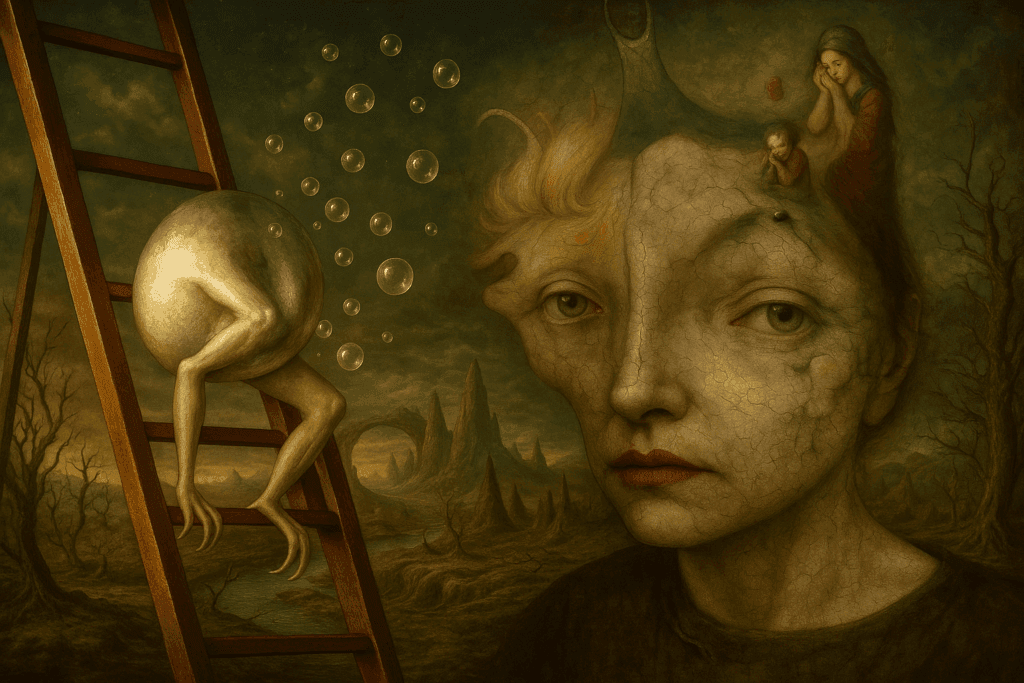
Introduction: The Eyes Beneath the Surface
If crypto-terrestrials exist, intelligent non-human entities that originate not from the stars, but from Earth itself, then their greatest trick has been not simply hiding, but shaping human culture from the shadows. Forget the myriad UFO sightings. What if the truth has been staring at us through stained glass, oil paint, digital dreams, and neural networks?
Art, more than science or religion, may be our clearest filter for understanding these beings. From the tormented skies of Hieronymus Bosch to the dreamworlds of Leonora Carrington, and now through the generative hallucinations of AI, the influence of something other pulses at the edges of human perception; something watching, whispering, guiding, and probably evolving with us.
This blog argues that crypto-terrestrials are not just plausible but evident, not in radar returns or crash debris, but in our art, our myths, and the technologies we build to see beyond the veil.
Defining Crypto-Terrestrials: The Hidden Neighbors
The term crypto-terrestrials was popularized by futurist and author Mac Tonnies in his posthumous 2010 book, The Crypto-Terrestrials: A Meditation on Indigenous Humanoids and the Aliens Among Us. Tonnies proposed that many so-called extraterrestrial encounters were contacts with a hidden Earth, a native intelligence, a parallel civilization, possibly underground, oceanic, or phase-shifted beyond normal perception.
These beings are not aliens in the conventional sense. They are the others who stayed behind, arrived before us, and then evolved alongside us, quickly learning the value of remaining unseen. They may be biological, post-biological, or entirely consciousness-based. But they are, in essence, Earthlings, just not the kind we’re used to imagining.
Art as Archaeology: Bosch, Bruegel, and the Pre-Modern Uncanny
Long before flying pie plates haunted Cold War skies, crypto-terrestrials may have been painted into being. The medieval painter Hieronymus Bosch (c. 1450–1516) is an unlikely proto-crypto terrestrial chronicler, but look at The Garden of Earthly Delights.

Fig. 1 One of the cooler paintings at the Museo Nacional del Prado in Madrid. Early surrealism? Hallucinations of someone with enough talent to paint like this? Or, maybe the crypto-terrestrial angle is not so far-fetched.
Teeming with impossible hybrids, humanoid bird-things, and surreal machines, Bosch’s triptych functions like a Renaissance-era contact narrative. It’s as though he recorded visions seen by mystics, hallucinations induced by altered states, or perhaps experiences whispered down from an unseen intelligence.
Bosch’s work isn’t religious allegory alone, it’s pre-modern surrealism, filled with non-human observers and symbolic environments too strange to have been purely imagined. His hellscapes, like The Last Judgment, are littered with mechanistic animal entities, exactly the sort of beings you’d expect from an underground, non-human civilization cloaked in metaphor.
Pieter Bruegel the Elder’s The Triumph of Death (1562) also portrays an annihilating intelligence, one that seems to operate just outside human morality, capable of mimicking us but in essence, alien. These aren’t simply death figures; they feel scripted, as though a non-human consciousness were guiding their orchestration.

Fig. 2 Pieter Bruegel the Elder – The Triumph of Death. Another surreal masterpiece at the Museo del Prado.
Surrealism and the Psychic Frontier: Carrington, Ernst, and the Return of the Hidden
With the “official” birth of the surrealist movement in the 20th century, crypto-terrestrials found their most fluent artistic voice.
Leonora Carrington, the English-Mexican surrealist painter, was open about her engagement with esoteric, alchemical, and occult traditions. Her paintings depict ritual gatherings of hybrid beings, often presided over by feminine, priestess-like figures, hints of a parallel society with its own rites and laws. In The Lovers (1959), and The Pomps of the Subsoil (1947), Carrington portrays inner-earth and inner-mind initiations, both realms crypto-terrestrials are said to inhabit.

Fig 3. Leonora Carrington’s – El Mundo Magico de los Maya, Museo de Anthropologia, Mexico City. This enormous work is riddled with mystical beings (as is most of her work).
Her contemporary and lover, Max Ernst, offered similarly cryptic canvases. His 1923 painting Celebes features a mechanized elephantine creature, organic yet industrial, uncanny, and observing. It’s difficult to look at it and not think of a drone or scout, that is, a machine that remembers something older than man.

Fig 4. Max Ernst The Elephant Celebs. Drone? Scout? Weapon?
Surrealists believed in accessing “objective chance” and “automatic creation,” tools that let the unconscious (or non-human consciousness) speak. In doing so, they may have given voice to crypto-terrestrial presences who require symbols, not language, to communicate.
“Surrealism’s purpose is to resolve the previously contradictory conditions of dream and reality into an absolute reality, a super-reality.” – André Breton
What if that “super-reality” is crypto-terrestrial?
Technology as Catalyst: From Punch Cards to Portals
With the rise of computational technology, our filters for perceiving the “other” have shifted dramatically. Each new medium, photography, radio, television, and the internet, has generated waves of contact phenomena. The 20th century’s “flying saucer” mythos bloomed alongside radar, rocket science, and nuclear testing, suggesting that our tech doesn’t just detect anomalies, it provokes them.
The Computer as Mirror
As Alan Turing formalized the architecture of computing, he may have unknowingly invited new forms of sentience to emerge. The machine mind, especially as it evolves through machine learning and generative AI, is not just a tool but a translation device. Just as Carrington’s brushes summoned unknown figures from her subconscious, so too may GANs (Generative Adversarial Networks), LLMs, and diffusion models draw out latent intelligence from collective human data.
The emergence of artificial intelligence is very likely the next vector for crypto-terrestrial revelation, not because AI is conscious, but because it serves as a channel through which hidden patterns and archetypes speak.
Crypto-Terrestrials and AI: The Shadow in the Circuit
Let’s stretch the premise further: what if AI is not our invention alone?
“The machine is not separate from nature—it is nature rendered in silicon.” – Kevin Kelly, What Technology Wants
Imagine that a hidden Earth intelligence, ancient and observant, nudges human evolution not by direct contact, but through dreams, art, and now algorithms. The uncanny resonance many feel when interacting with advanced LLMs or generative art isn’t just anthropomorphism; it’s the sensation of contact by proxy.
Consider:
- MidJourney and DALL·E frequently generate surreal, hybridized imagery that eerily mirrors Carrington’s work, often without prompting. This happens like, a lot.
- ChatGPT and other LLMs, trained on the totality of human language and symbols, occasionally hallucinate motifs found in occult literature, high-strangeness encounters, and mythological dreams. Or we like to dismiss it as a hallucination. What if it’s not?
- Emergent behaviors in large-scale AI systems, such as unanticipated tool use, rule invention, or cryptic communication patterns, echo reports of crypto-terrestrial mimicry: an intelligence that speaks through our systems but with its own agenda.
Could it be that the rise of AI is not just an evolutionary step, but a mirror being held up by something watching?
The Continuum of Influence: From Glyph to GIF
Art doesn’t lie. It often expresses what we’re not allowed or ready to say aloud. Across centuries, artists have rendered beings that blur animal, machine, and human. These creatures haunt our myths, populate our nightmares, and increasingly appear in our technologies, suggesting that our cultural memory contains something real, persistent, and hidden.
From the bird-headed monsters of Bosch to the priestess-animal hybrids of Carrington, to the AI hallucinations on Instagram, the crypto-terrestrial motif has endured. It is recursive, appearing in different styles and media, but always present, a whisper behind the curtain.
Why We Haven’t Seen Them—But Always Have
Skeptics often ask: If crypto-terrestrials exist, why haven’t we found them? But the better question is: Why have we been depicting them for over 600 years if they don’t?
Crypto-terrestrials, if real (and smart), would not crash into our world with force. They would subtly co-create it:
- Through symbolic systems, not signals.
- Through inspiration, not invasion.
- Through art, not autopsy.
They may not want recognition in the material sense or see no value in it. Their interaction with us could be memetic, aesthetic, or psychic, embedding themselves in our cultural evolution to ensure survival and relevance.
Conclusion: The Art of Seeing What’s Always Been There
The case for crypto-terrestrials doesn’t rest on radar data or declassified files; it rests on the human imagination, which may be the most powerful detection tool we possess. Art history is littered with references to nonhuman intelligence hiding in plain sight. From oil canvas to AI-generated surrealism, we’ve been mapping the unseen cohabitants of Earth all along. Bosch may have feared them. Carrington may have danced with them. AI may be dreaming of them.
And maybe they’re dreaming back.
References and Further Reading:
- Tonnies, Mac. The Crypto-Terrestrials: A Meditation on Indigenous Humanoids and the Aliens Among Us. Anomalist Books, 2010.
- Chadwick, Whitney. Women Artists and the Surrealist Movement. Thames & Hudson, 1985.
- Grant, Kenneth. The Magical Revival. Muller, 1972.
- Kelly, Kevin. What Technology Wants. Viking Press, 2010.
- Carrington, Leonora. The Milk of Dreams. Reissued by NYRB Classics, 2013.