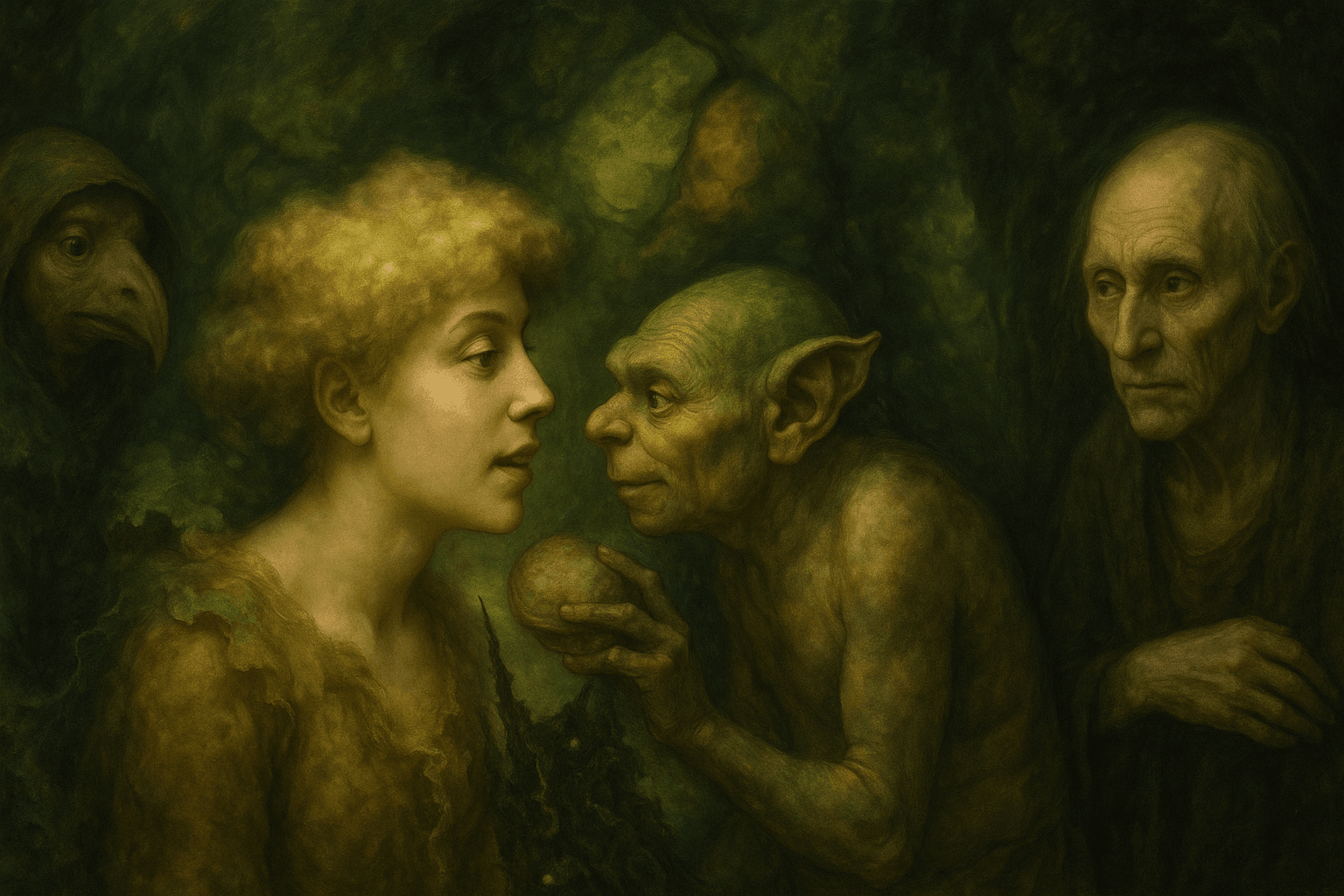
“I believe in the future resolution of these two states, dream and reality, which are seemingly so contradictory, into a kind of absolute reality, a surreality.” — André Breton
In the age of data, sensors, and logic gates, the idea that dreams, myths, and art might reveal something more real than reality feels heretical. But what if we’ve been looking for proof in the wrong places? What if, instead of radar pings or telescope signals, we’ve already received transmissions, etched not in binary code, but in oil paint, sculpture, and dreams? What if the surrealists, the physicists, and the myth-makers were all tuning into the same hidden frequency?
Let’s explore a hypothesis that defies disciplinary silos and invites you to consider a provocative possibility: that quantum entanglement, crypto-terrestrial intelligences, and surrealist art are connected threads in a deeper tapestry of reality, one that stretches across time, consciousness, and perception itself.
Quantum Entanglement: A Glimpse into Non-Local Consciousness
Let’s begin with physics. Quantum entanglement refers to a phenomenon where two or more particles become linked in such a way that their states are instantaneously correlated, no matter the distance between them. Measuring the state of one particle instantly determines the state of the other, even if they’re separated by light-years. It’s not just weird. It breaks our classical understanding of causality and space.
Einstein, skeptical of this “spooky action at a distance,” never accepted it. But experiments have since confirmed it repeatedly. Quantum information moves in a way that seems to transcend space and time. It’s not that the particles communicate. Rather, it’s as if they are expressions of a single, non-local reality.
Some theorists, most notably Roger Penrose and Stuart Hameroff, have speculated that this same quantum behavior might be embedded in consciousness itself. If our minds are partially quantum in nature, then under certain states, dreams, trance, psychedelia, or trauma, they might momentarily “detune” from normal space-time and entangle with other informational structures.
That raises a radical question: entangled with what?
Crypto-Terrestrials: The Hidden Others
And now we run further down the rabbit hole: the crypto-terrestrial hypothesis.
Unlike the classic extraterrestrial narrative (beings arriving in spaceships from other planets), the crypto-terrestrial idea suggests that non-human intelligence may have always been here. Beneath the ground, within the oceans, behind the veil of ordinary perception, co-evolving with us, maybe even shaping our myths and dreams from the beginning.
The late Mac Tonnies and other researchers speculated that these beings operate on a spectrum of visibility and cognition that humans only occasionally tap into, through altered states, liminality, and symbolic resonance. Some theories suggest they are biologically distinct and live in hidden geographies. Others propose they are dimensional or quantum in nature, phasing in and out of perceptual range like figures in a lucid dream.
Such entities wouldn’t be bound by physical appearance. Their interface with us might occur primarily through archetypes, metaphor, and imagination. In other words, through symbols, art, and myth.
What if these crypto-terrestrials are not just watching, but co-dreaming with us, using our minds as receivers, our symbols as syntax?
Surrealism: Painting the Voice of the Other
Surrealism was not just an art movement. It was a metaphysical revolution. André Breton’s 1924 Surrealist Manifesto declared that the rational mind had failed and that it was time to explore the unconscious as a legitimate source of truth. Artists were to become “automatons” channeling the unseen. Dreams, hallucinations, and spontaneous expressions were no longer dismissed as irrational but embraced as portals to a hidden order.
Surrealist pioneers like Salvador Dalí, Max Ernst, Leonora Carrington, and Remedios Varo filled their canvases with forms that seemed half-dream, half-entity: beings that shimmered between species, realms, and realities. Their works evoke an uncanny familiarity; we’ve seen these figures before, not in waking life, but in dreams, rituals, or childhood fever states.
These artists were obsessed with the Other, the unknown, the ambiguous. But what if their surreal visions weren’t just psychological excavations? What if they were entangled downloads, interpretations of information received through a non-local interface with a crypto-terrestrial intelligence? I know this sounds weird. Bear with me.
The Interface Hypothesis: Entanglement as a Transmission Medium
Here’s where the threads tighten.
Quantum entanglement presents us with a model of instantaneous, non-local information transfer. If consciousness participates in entangled systems, especially under conditions where the ego is suspended (dreams, trance, art-making), then certain individuals may act as receivers of information not native to their own minds.
In this view, surrealist artists may have functioned as antennae, attuned to frequencies that most people filter out. The strange, otherworldly beings and architectures they painted were not hallucinations but renderings of actual transmissions, filtered through metaphor and visual language.
Imagine this: just as SETI listens for structured radio signals from distant stars, surrealist artists may have been rendering structured symbolic signals from parallel cognitive dimensions; crypto-terrestrial broadcast channels using archetypal imagery as their carrier wave.
This is not an argument for telepathy in the sci-fi sense. It’s an argument that entangled consciousness is capable of symbolic reception, and that surrealist art is a byproduct of that entangled dialogue.
From Bosch to Carrington: A Historical Timeline of Transmission
The idea that visual art channels non-human intelligences isn’t new. Consider:
-
- Hieronymus Bosch (1450–1516): His infernal dreamscapes prefigure surrealism by 400 years. His “Garden of Earthly Delights” depicts creatures and machinery no one had context for, like unconscious glimpses of impossible worlds.
-
-
- William Blake (1757–1827): Claimed to receive visions from angels and otherworldly beings. His mythopoetic cosmology, rich in symbolism, was more visionary than theological.
-
- Remedios Varo (1908–1963): Her paintings often feature esoteric machines powered by dreams and lunar energy, machines that resemble speculative technology more than fantasy.
-
- Leonora Carrington (1917–2011): Her art is a fever dream of hybrid beings, arcane rituals, and mythic rebirth. She once claimed that “there are things that are not sayable, that can only be expressed through painting.”
Each of these artists, across time and culture, seems to have tapped into a shared symbolic language, a language that hints at another intelligence using human imagination as a soft channel for contact.
Myth as Metadata: The Archetype as Protocol
Carl Jung viewed archetypes as universal patterns in the collective unconscious. But if we take the crypto-terrestrial hypothesis seriously, archetypes may also serve as metadata protocols, a kind of shared formatting system between human and non-human cognition.
Just as modern APIs allow two different software systems to communicate, archetypes may be the cognitive interface between species. The serpent, the eye, the spiral, the hybrid, these aren’t just recurring motifs. They are symbolic scaffolds that allow communication across consciousness models.
Surrealism, then, becomes a ritualized decoding method, an artistic version of a Fourier transform, turning non-linear, dreamlike signals into interpretable structure. The artwork is the waveform. The viewer is the interpreter. And the crypto-terrestrial… is the sender.
Toward a Unified Theory of the Unseen
This triangulated theory, entanglement as a mechanism, crypto-terrestrials as intelligence, surrealist art as medium, has implications that are both thrilling and disturbing.
If true, it would mean:
-
-
The human mind is not a closed-loop system.
It is porous, an organ not merely of thought, but of transmission. In dreams, trance, grief, ecstasy, and deep creation, the boundaries of the self grow thin. Under such conditions, the mind becomes a threshold rather than a container, capable of entanglement with patterns, presences, and intelligences beyond its own making. -
Art is not just expression, but reception.
It is a liminal technology, an antenna tuned to frequencies most of us have forgotten how to hear. In this view, the artist becomes a medium, not merely producing images but translating signals from a larger cognitive ecosystem, one that may include non-human minds operating through metaphor, archetype, and symbol. -
Reality is not strictly physical, but symbolically networked.
Beneath matter lies meaning, structured like a language whose syntax is myth and whose grammar is dream. Consciousness becomes the decoding interface, a kind of biological semiotic processor, capable of navigating a reality that is less a fixed landscape and more a shifting web of interwoven perception and intent.
-
This also reframes the UFO/UAP discourse. Rather than thinking of aliens as beings piloting nuts-and-bolts spacecraft from Alpha Centauri, we might consider them semiotic agents, symbols made sentient, or consciousnesses cloaked in archetype.
We may be looking at the wrong sky. The real contact might not come in the form of a flying saucer but in the brushstroke of a Carrington, the dream of a shaman, or the unplaceable familiarity of a surrealist canvas.
Final Thought: The Invitation
None of this is provable in the strict scientific sense—yet. But like any good theory, it opens new ways of seeing.
Whether you’re an artist, a physicist, or a mythologist, consider the possibility that reality is multi-threaded, that the boundaries between self and other, real and imagined, may be entangled in ways our current models can’t yet capture.
When you next look at a surrealist painting, when you see a melting clock, a hybrid beast, a ritual machine, ask not what does it mean, but rather: who is speaking to me through this?
Because just perhaps, you’re not hallucinating.
You’re receiving.
Further Reading and Sources
-
- Tonnies, Mac. The Cryptoterrestrials: A Meditation on Indigenous Humanoids and the Aliens Among Us.
-
-
- Penrose, Roger & Hameroff, Stuart. Orch-OR: A Model for Consciousness Based on Quantum Physics.
-
- Jung, Carl. Man and His Symbols.
-
- Breton, André. Manifestoes of Surrealism.
-
- Carrington, Leonora. The Hearing Trumpet and associated artworks.
-
- Varo, Remedios. Unexpected Journeys (exhibition catalogue).
-
- Sheldrake, Rupert. Morphic Resonance and the Presence of the Pas,